
What Is Executive Presence? A Voice Coach’s Guide to Sounding Credible, Calm and Influential
Pavan
November 19, 2026

You can be the most knowledgeable person in a meeting and still struggle to hold the room. You can have a strong résumé, excellent ideas and years of experience—and still hear some version of: “You need more executive presence.”
The frustrating part is that people often know executive presence when they experience it, but struggle to explain exactly what it is. Is it confidence? Charisma? A deep voice? The ability to speak without notes? Strong eye contact? An expensive suit? Being the loudest person at the table?
Not quite.
Executive presence is better understood as the impression that you can be trusted with consequential responsibility. It is what people infer from the way you think, speak, listen, decide and respond when the stakes rise.
That distinction matters.
Executive presence is not a personality type. It does not require becoming extroverted, intimidating or artificially polished. And from a voice-coaching perspective, it certainly does not mean manufacturing a stereotypical “CEO voice.” It is the alignment of substance, composure and communication so that other people can hear and see the leadership capacity that already exists behind your words.
Research supports the importance of that perception. In a widely cited Center for Talent Innovation study, 268 senior executives estimated that executive presence accounted for about 26% of what it takes to earn the next promotion. That figure should be understood as leaders’ perception of promotion criteria rather than a causal formula, but it illustrates how seriously senior decision-makers take the subject.
Your voice is one of those signals. Not the only one—but a powerful one.
This guide looks at executive presence through that lens: what the research says, what has changed in modern leadership, how vocal behaviour affects perception, which popular myths should be discarded, and how to build a more credible leadership presence without losing the voice that makes you recognisably yourself.
The Short Answer: What is Executive Presence?
Executive presence is the collection of behaviours and signals that cause other people to perceive you as capable of handling leadership responsibility.
One of the more rigorous academic attempts to define the concept came from researchers Gavin Dagley and Cadeyrn Gaskin. After interviewing 34 professionals with expertise in executive effectiveness, they concluded that executive presence is fundamentally audience-dependent. A person with presence is perceived as exerting influence beyond what their formal position alone would give them. That is an important definition because it separates authority from presence.
A title can give you authority. Presence helps people want to listen.
The researchers identified characteristics that influence early impressions—including projected confidence, communication ability and engagement skills—as well as characteristics judged over time, including integrity, expertise, values and the ability to deliver outcomes. In other words, executive presence operates on two timescales.
There is the presence people experience when you enter a meeting, answer a difficult question or begin a presentation. Then there is the presence people discover after working with you for six months.
The first is partly communication. The second is character and performance. Sustainable executive presence needs both.
Why Executive Presence Matters
Senior leadership changes the nature of your work. Early in a career, competence can often be demonstrated through execution: solve the problem, complete the analysis, deliver the project. At senior levels, people increasingly have to make decisions without perfect information, represent ideas they did not personally create, persuade stakeholders with competing interests, explain complexity simply, respond under pressure and create confidence in other people.
Your expertise still matters enormously. But expertise that cannot be communicated is difficult for other people to use. That is where executive presence enters.
Sylvia Ann Hewlett’s influential research on the subject identified three broad dimensions: gravitas, communication and appearance. Among the 268 senior executives in the original research, 67% identified gravitas as the central element, compared with 28% for communication and 5% for appearance.
That does not mean executive presence can literally be calculated as 67% gravitas + 28% communication + 5% appearance. It means respondents overwhelmingly considered how a leader acts more important than how a leader looks. That is a useful corrective to much of the superficial advice surrounding executive presence.
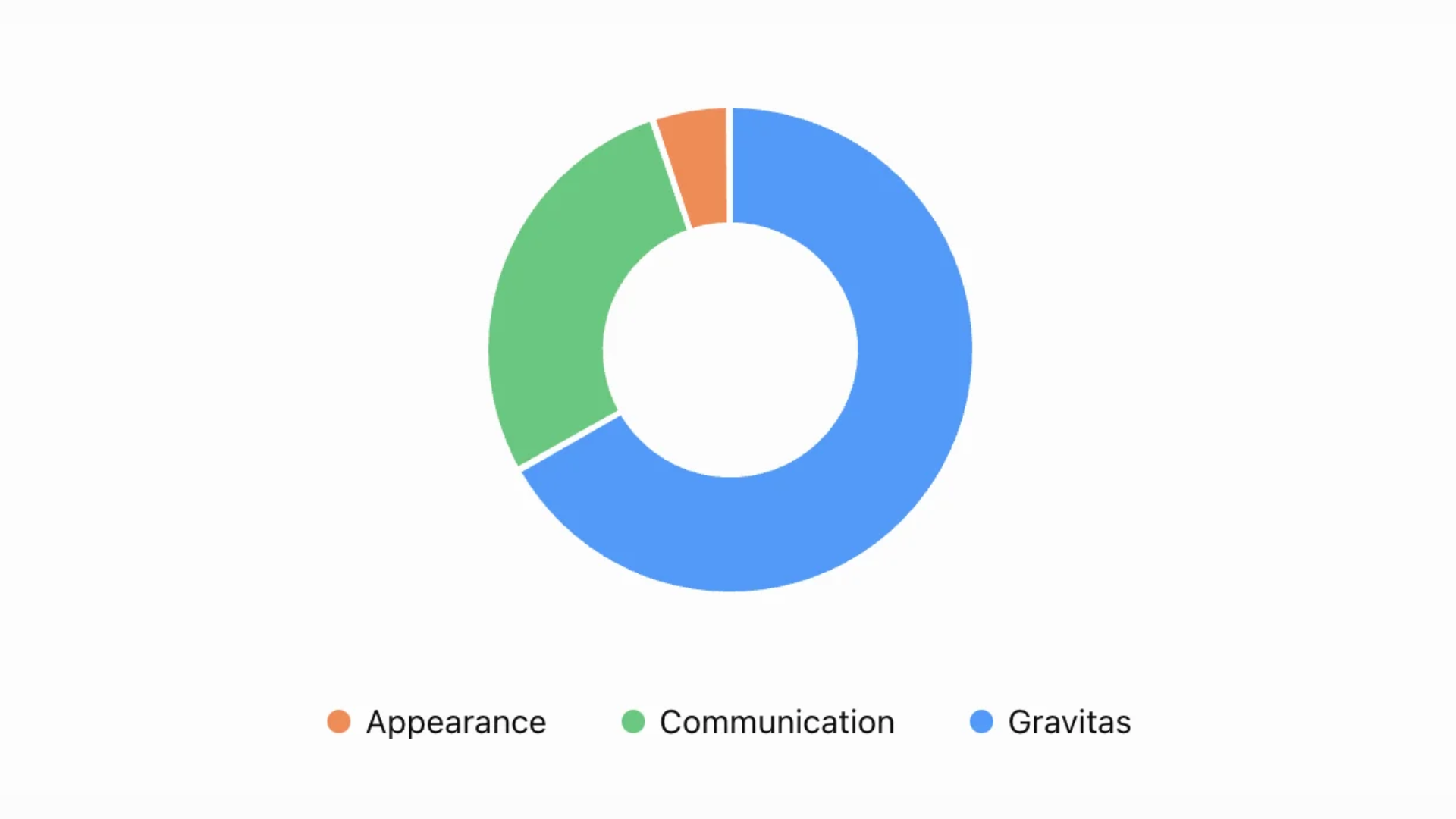
- Gravitas: 67%
- Communication: 28%
- Appearance: 5%
This is the cleaner way to visualise the famous 67/28/5 finding: as the proportion of senior executives identifying each area as central, rather than pretending it is a mathematical recipe for leadership.
Executive Presence has Changed
The stereotype of executive presence used to be remarkably narrow. It often rewarded a certain corporate archetype: forceful, polished, certain, impeccably dressed, able to dominate a room and rarely visibly unsettled.
Some of those signals still matter. But the definition has evolved.
Hewlett compared surveys conducted in 2012 and 2022. The earlier survey included 268 U.S. business executives at director level or above; the later survey included 73. Both groups evaluated leadership traits associated with executive presence. Confidence and decisiveness remained important, but inclusiveness, respect, listening and authenticity became substantially more prominent in the newer model.
The gravitas findings are revealing:
| Gravitas trait | 2012 | 2022 |
|---|---|---|
|
Confidence |
77% |
76% |
|
Decisiveness |
70% |
71% |
|
Integrity |
63% |
60% |
|
Vision |
52% |
61% |
|
Inclusiveness |
– |
68% |
|
Respect for others |
– |
65% |
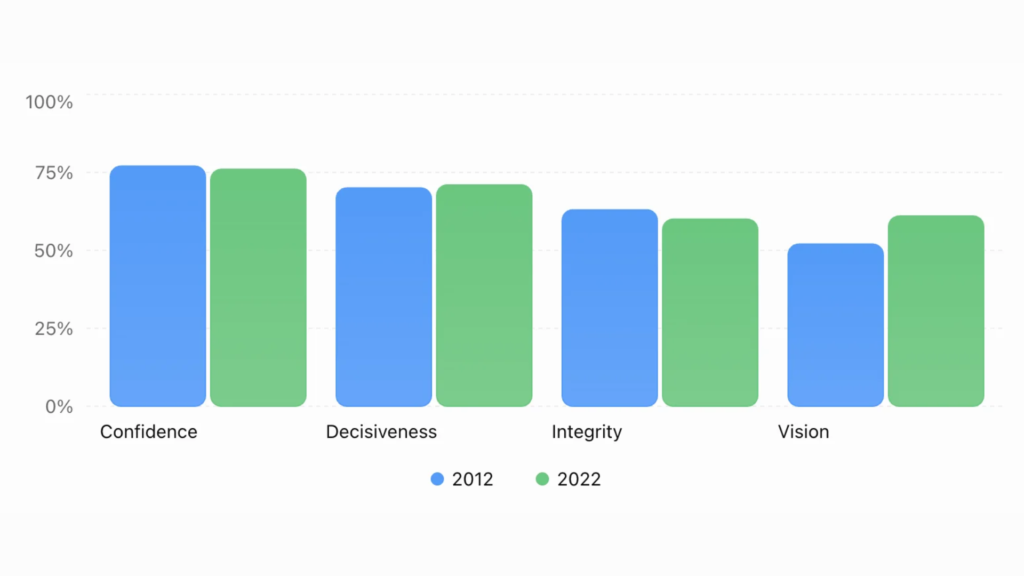
Superior speaking ability also remained highly valued in communication, rising from 62% in the 2012 survey to 66% in 2022. Command of a room(or Zoom) remained almost unchanged at 52% versus 53%. But the newer survey also elevated a “listen to learn” orientation and authenticity. That gives us a more useful model of modern leadership presence:
Authority has not disappeared. It has become more relational.
A contemporary executive may still need to make a difficult decision quickly. But that executive also needs the ability to listen before deciding. A leader may need to command a town hall. But that same leader needs to create space for other people in a strategy meeting. A leader must project confidence. But confidence without curiosity can quickly become arrogance.
A 2026 Harvard Business Review article makes precisely this point: behaviours that often help people rise—having answers, projecting certainty and jumping in with solutions—can become liabilities at higher levels when those behaviours prevent others from contributing.
That is why executive presence should never be confused with maximum dominance. The goal is not to occupy the most conversational space. The goal is to create enough confidence that the room can move forward.
A Voice Coach's Definition of Executive Presence
From a voice-coaching perspective, executive presence can be described in one sentence:
Executive presence is the ability to make your thinking, authority and intention perceptible through the way you regulate yourself, structure your message and use your voice in relationship with other people.
Notice what is not included in that definition.
- There is no requirement for a naturally deep voice.
- No requirement to sound like a broadcaster.
- No requirement to eliminate your accent.
- No instruction to speak slowly at all times.
- No demand that you become louder.
- And no assumption that charisma and leadership are identical.
Instead, the coaching question becomes:
Does the way you sound support the meaning you intend?
- If you say, “I recommend we proceed,” but your pitch rises uncertainly, your volume falls away and you immediately add three qualifications, listeners may receive a different message from the sentence you chose.
- If you announce a serious problem at high speed without pausing, the room may hear anxiety where you intend urgency.
- If you speak powerfully for ten minutes but never make room for another voice, people may hear self-confidence without leadership.
- If your voice becomes tight and shallow every time a senior colleague challenges you, your nervous system may become part of the communication whether you intend it to or not.
Executive voice training therefore is not about creating a beautiful voice. It is about making your voice a more accurate carrier of your thinking.
The Six Vocal Signals that Shape Executive Presence
The following framework is a coaching model, not a validated scientific scale. It translates findings from speech research, communication psychology and practical voice training into six trainable dimensions.
| Vocal Signal | What listeners may infer | Common Problem | Coaching Objective |
|---|---|---|---|
|
Physiological steadiness |
Composure |
Tight breath, rushed onset, shallow support |
Regulate before speaking |
|
Pace |
Cognitive control and urgency |
Habitual rushing or artificial slowness |
Vary speed according to meaning |
|
Pausing |
Deliberation and structure |
Filling every silence |
Make silence intentional |
|
Pitch and melody |
Confidence, engagement, emotional meaning |
Monotony or uncontrolled rise/fall |
Increase purposeful variation |
|
Resonance and intensity |
Energy and audibility |
Pushing, shouting or fading |
Create supported projection |
|
Articulation and phrasing |
Clarity and command of material |
Mumbled endings, long sentences |
Make thought structure audible |
1. Physiological Steadiness: Presence Begins Before the First Word
Executive presence is often most visible when something goes wrong.
- A hostile question.
- An unexpected objection.
- A presentation slide that fails.
- A client who disagrees.
- A senior leader who says, “I don’t understand why we’re doing this.”
In those moments, listeners are not only processing your answer.
They are observing what happens to you.
- Does your breathing shorten?
- Do your shoulders rise?
- Does your voice accelerate?
- Does your pitch become unstable?
- Do you start explaining before you have decided what you actually think?
This is one reason breathing and physical regulation matter in voice training. The goal is not to perform a theatrical breathing technique while someone waits for an answer. It is to build enough coordination that your body does not pull your speech into panic speed.
A useful executive habit is to allow a short moment between stimulus and response. Hear the question. Breathe. Decide the headline. Then speak. That half-second of internal organisation can change the entire sound of an answer.
2. Pace: Authority is Not the Same as Speaking Slowly
“Speak slowly to sound powerful” is incomplete advice. Research suggests that speech rate, intonation and pitch can influence how confident a speaker sounds, but the relationship is contextual rather than governed by one universal ideal.
In a series of three experiments involving 394, 412 and 397 participants—a combined 1,203 participants—researchers manipulated speech rate, intonation and pitch and found that those vocal properties changed listeners’ perceptions of speaker confidence, which in turn could influence persuasion.
The lesson is not “fast is good” or “slow is good.” It is that pace carries meaning.
- A leader explaining urgent operational actions may appropriately accelerate.
- A leader announcing a major strategic change may slow around the central message.
- A leader answering a difficult board question may begin deliberately, become more fluid through the explanation and slow again for the conclusion.
Presence comes from control of pace, not from one pace.
A useful test is to record yourself answering:
“What is the single most important issue our organisation must solve this year?”
If every sentence has roughly the same speed, your delivery may be technically fluent but rhetorically flat. Leadership speech needs hierarchy. Your voice should tell listeners what matters most.
3. Pausing: Silence is Part of Executive Communication
Many professionals treat silence as evidence that they have forgotten something. So they fill it.
“Um.” “Basically.” “You know.” “Like.” “So…”
Or they simply keep speaking.
But a purposeful pause does something valuable: it separates one thought from the next. Pause length is highly contextual. One study examining impressions of English speech found that approximately 0.6-second pauses worked well for naturalness in its particular experimental conditions, but that should not be treated as a universal executive-speaking formula.
The more useful coaching principle is structural. Pause after the idea, not because you ran out of air in the middle of it.
Compare: “We believe… the strongest opportunity is… Southeast Asia because… the demographic trends…”
with: “We believe the strongest opportunity is Southeast Asia. Pause. There are three reasons.”
The words are almost the same. The leadership signal is not. The second version sounds as though the speaker knows where the thought begins and ends. That is one of the quietest forms of gravitas.
4. Pitch: Stop Trying to Manufacture a “Leadership Voice”
One of the most persistent voice-training myths is that a lower voice automatically creates authority. The research is much more interesting.
A study of 792 male public-company CEOs found an association between lower vocal pitch and the size of the companies they led; an interquartile pitch decrease of 22.1 Hz was associated with larger firm size and higher compensation. But this was an observational study of male CEOs. It does not establish that lowering a person’s pitch causes career success. Other experimental work complicates the “lower is always stronger” story.
Research published in Psychological Science found that people placed into higher-rank conditions changed several acoustic characteristics of their voices. Listeners, in turn, used pitch, loudness and loudness variability when estimating hierarchical rank. The pattern was not simply “lower pitch equals higher status.”
Cross-gender and cross-language research on charismatic speech reaches a similarly nuanced conclusion: speakers manipulate combinations of fundamental frequency and sound-pressure level according to gender, language, culture and communicative goal.
So what should an executive actually train?
Not “a lower voice.” Train range, stability and intention.
- You need enough pitch movement to make contrasts audible.
- You need enough stability that nerves do not control your melody.
- And you need the ability to end important statements as statements rather than allowing every sentence to drift into uncertainty.
The goal is your most credible voice—not somebody else’s deepest voice.
5. Resonance and Projection: Authority Without Shouting
Projection is frequently confused with volume. They are not the same thing. Someone can be loud and still sound strained. Another person can speak at a moderate volume and carry effortlessly across a room because the voice is efficiently supported and resonant.
Executive projection means giving the voice enough acoustic energy to arrive intact.
- That matters in boardrooms.
- It matters in training rooms.
- It matters on stage.
- And it matters online, where poor microphone position and low vocal energy can make a capable speaker sound distant.
The coaching goal is therefore not “be louder.”
It is: Be easy to hear without sounding as though you are trying to be heard.
That distinction is central to credible vocal authority.
6. Articulation and Phrasing: Make the Thinking Visible
Some communication problems that appear to be “voice problems” are actually thinking-structure problems. The speaker knows too much. So everything sounds equally important.
- The answer becomes four minutes long.
- Every qualification arrives before the recommendation.
- Sentences contain multiple subordinate clauses.
- Technical context overwhelms the decision.
- The listener has to perform the editing.
Senior audiences rarely want more information first. They usually want orientation. A strong executive answer therefore often follows this architecture:
Conclusion → reason → evidence → implication.
For example: “Delay the launch by two weeks. The security risk is still above our threshold. Testing identified three unresolved vulnerabilities yesterday. A short delay protects the client relationship and prevents a much more expensive correction after release.”
That sounds authoritative partly because of the language. But listen to what the voice can do with the structure.
“Delay the launch by two weeks.” Pause. “The security risk is still above our threshold.” Pause. “Testing identified three unresolved vulnerabilities yesterday.”
Then finish with the consequence.
The voice converts information into hierarchy. That is executive communication.
Executive Presence is Also Listening
Perhaps the most important change in modern executive presence is that communication is no longer synonymous with speaking impressively.
Hewlett’s newer research gives explicit prominence to a listen-to-learn orientation. This matters enormously in voice training because conversational presence can be undermined by habits that appear verbally polished.
- Finishing other people’s sentences.
- Answering before the question is complete.
- Using every pause as an opportunity to enter.
- Redirecting every contribution toward your own experience.
- Speaking longer because silence feels uncomfortable.
A strong leader may sometimes be the person speaking least. Presence can be visible in the quality of the attention. When you listen well, your eventual response becomes more powerful because it responds to what was actually said rather than what you expected to hear.
That is the difference between waiting to speak and listening to learn.
Executive Presence Does Not Mean Eliminating Your Accent
Voice coaching needs an ethical distinction between clarity and conformity. People make judgments based on accent. Unfortunately, some of those judgments are biased.
A meta-analysis integrating 139 effect sizes and 4,576 participants found that candidates with standard accents were rated as more hireable than candidates with non-standard accents. Importantly, differences in comprehensibility did not fully explain the effect, indicating that social status and prejudice also play a role.
A 2025 meta-analysis of employment-interview research likewise found a consistent bias favouring standard-accented candidates, with an overall effect size of d = 0.46. The authors found that stereotypes about competence explained more of the bias than actual comprehensibility or the speaking demands of the job.
This matters for executive voice coaching. The goal should not automatically be “accent reduction.” The more useful questions are:
- Can people understand you easily?
- Can you stress the words that carry meaning?
- Can you control pace?
- Can you vary tone intentionally?
- Can you speak effectively across different cultural and professional contexts?
- Can you retain your identity while increasing communicative range?
An accent is not a leadership defect.
Clarity is trainable. Flexibility is trainable. Presence is trainable. Identity does not need to be erased in the process.
The 7–38–55 Myth: Your Words Do Matter
Communication training has repeated one statistic for decades:
“Only 7% of communication comes from words, 38% from voice and 55% from body language.”
That is not a valid general rule of communication.
Albert Mehrabian’s original work concerned much narrower situations involving communication of feelings and attitudes, particularly when verbal and nonverbal signals conflicted. It was not evidence that the content of a board presentation accounts for only 7% of its meaning. This is especially important for executive communication. Your voice matters. Your body language matters. And your words still matter enormously.
If the strategy is incoherent, excellent resonance will not repair it. If the recommendation is unsupported, confident intonation does not make it sound. Executive presence works when delivery reinforces substance. Not when delivery replaces it.
Executive Presence Versus Confidence
Confidence is part of executive presence, but the two are not identical. Confidence describes a person’s certainty or self-belief.
Executive presence describes the effect of a larger pattern of behaviour on other people’s perceptions.
A person can be extremely confident and have poor executive presence. For example, someone might interrupt repeatedly, dismiss objections, dominate airtime and make decisions without sufficient information. That person is not lacking confidence. They may be lacking judgment.
Conversely, someone can experience internal nerves while projecting considerable presence because they remain clear, prepared, respectful and composed. This is useful for professionals who assume they must somehow “feel confident” before they can sound confident.
You do not. You can train the behaviours before the feeling fully catches up.
Executive Presence Versus Charisma
Charisma can increase attention. Executive presence has to survive scrutiny. Charismatic speech has been studied acoustically, and research suggests that pitch range, intensity and voice quality can contribute to perceptions of charisma. But charisma alone is not sufficient for leadership presence.
Remember Dagley and Gaskin’s distinction between impressions formed quickly and qualities evaluated over time. A charismatic person may create a remarkable first impression. If that person does not deliver, act with integrity or demonstrate expertise, the presence becomes unsustainable.
The opposite is also possible. A quiet leader may initially appear understated but acquire enormous presence because colleagues repeatedly observe excellent judgment, consistency and outcomes. Executive presence therefore does not require performing charisma.
Executive Presence Versus Dominance
Dominance says: “Notice me.”
Presence says: “You can rely on me.”
Sometimes those behaviours overlap.
A crisis may require a leader to interrupt, decide and give unambiguous direction. But leadership is contextual. In a creative discussion, excessive dominance can reduce the contribution of everyone else. In a difficult one-to-one conversation, forcefulness may make honesty less likely. At senior levels, the most powerful voice in the room may be the one that asks:
“What are we missing?”
That is why executive presence requires range.
How Executive Presence Sounds in a Meeting
Imagine a senior manager presenting a recommendation.
Version one:
“So, I just wanted to quickly take you through some of the work we’ve been doing, and obviously there are a number of factors we need to consider, but I think possibly the best option may be to delay the launch slightly…”
Version two:
“My recommendation is to delay the launch by two weeks.” Pause. “There are three reasons: security risk, client readiness and regulatory approval.”
Nothing about version two requires a deeper voice. The difference is cognitive and vocal organisation. The speaker has decided what matters. The listener does not have to search for the point. That is one of the most practical definitions of executive communication:
Reduce the listener’s effort without reducing the quality of your thinking.
How Executive Presence Sounds Under Pressure
Consider a challenging question: “Why didn’t your team identify this risk earlier?”
A defensive response often begins too quickly: “Well, actually, we did flag some concerns previously, but at the time the data wasn’t complete and there were several different teams involved…”
The speaker is already arguing. An executive response might be:
“We should have identified it earlier.” Pause. “The early indicators were there, and we underestimated them. We’ve corrected the monitoring process, and I can show you exactly what changes tomorrow.”
That answer demonstrates several aspects of gravitas at once.
- Accountability.
- Composure.
- Clarity.
- Action.
Notice again that vocal power comes partly from not rushing away from the uncomfortable sentence.
The Executive Voice is Context-Sensitive
There is no single ideal executive voice because leadership situations ask for different signals.
| Situation | Vocal priority |
|---|---|
|
Board presentation |
Precision, concise phrasing, calm authority |
|
Crisis communication |
Stability, clarity, decisive pacing |
|
Team town hall |
Energy, warmth, accessibility |
|
Negotiation |
Controlled pace, listening, strategic silence |
|
Performance conversation |
Warmth, firmness, low defensiveness |
|
Media interview |
Brevity, message discipline, vocal steadiness |
|
Virtual meeting |
Clear articulation, intentional turn-taking, microphone awareness |
|
Keynote speech |
Range, storytelling, rhythm and projection |
The executive who uses exactly the same vocal style in every situation has not mastered presence. They have mastered a habit.
Virtual Executive Presence
Video meetings remove some of the physical cues available in a room and amplify others.
- Small vocal habits become more noticeable.
- Interruptions feel sharper.
- Monotony feels flatter.
- Poor audio reduces credibility regardless of the speaker’s expertise.
- Long answers are harder to tolerate.
The communication standard therefore changes slightly.
- A good virtual executive answer is often shorter.
- The opening sentence matters more.
- Eye-line and camera framing matter.
- And vocal variation becomes particularly valuable because the listener has less environmental stimulation.
Hewlett’s updated research explicitly reflected this shift by referring to command of a “room/Zoom” and the rising importance of comfort with virtual communication. Presence did not disappear when work moved onto screens. Its acoustic component became more exposed.
How to Develop Executive Presence: A Practical Voice-Training Protocol
Executive presence is not developed by memorising a collection of “power poses” before a meeting. It develops through repeated behavioural practice with feedback.
Research on workplace and executive coaching supports the broader principle that coaching can improve leadership and personal outcomes. A 2023 meta-analysis of 37 randomized controlled studies, comprising 39 samples and 2,528 participants, found a statistically significant overall effect of workplace coaching, with the authors estimating a moderate standardised effect size of g = .59, while also noting indications of publication bias.
A useful voice-and-communication development cycle is:
Record → Diagnose → Isolate → Practise → Pressure-test → Review
Record a real or simulated business response. Diagnose one observable behaviour rather than judging whether you “sound good.” Isolate the skill—for example, pausing after the headline. Practise it repeatedly. Pressure-test it with difficult questions. Review the recording and repeat.
The simplicity is deliberate.
Executive communication improves when vague aspirations become observable behaviours.
- “Have more gravitas” is difficult to practise.
- “State the recommendation in the first 15 seconds” is trainable.
- “Sound more senior” is vague.
- “Finish the key sentence, pause, then give the supporting evidence” is trainable.
- “Be confident” is abstract.
- “Keep your pace stable when challenged and remove the apologetic preamble” is trainable.
A Five-Minute Executive Presence Practice
You do not need a stage to practise leadership presence. Take one real business issue and answer this question into your phone:
“What do I recommend, and why?”
Give yourself 60 seconds. Listen once without criticising your voice. Instead, evaluate four things.
- Did the recommendation appear in the first sentence?
- Did the important words receive vocal emphasis?
- Did you pause between major ideas?
- Did your final sentence actually finish, or did you fade away?
Then record it again.
Do not try to “sound confident.” Try to make the thinking clearer. The voice usually improves as a consequence.
A 30-Second Executive Answer Structure
When time is limited, use three parts:
Position. Reason. Next step.
For example: “My recommendation is to proceed with Option B. It gives us the best balance of speed and regulatory risk. If the board agrees today, the team can begin implementation on Monday.”
That is enough.
Many talented professionals lose presence because they feel responsible for including every detail they know. Senior communication often requires the opposite skill: Knowing what to leave available for the second question.
Measure Executive Presence with Behaviours, Not Adjectives
“Executive presence” becomes unhelpful when it is used as an unexplained performance-review label. Instead of asking, “Do I have executive presence?” ask questions that can produce evidence.
| Area | Diagnostic question |
|---|---|
|
Message |
Can I state my recommendation in one sentence? |
|
Pace |
Does my speed increase when I am challenged? |
|
Pausing |
Do I create space between important ideas? |
|
Voice |
Can I vary energy without sounding theatrical? |
|
Breathing |
Does physical tension alter my voice under pressure? |
|
Listening |
Do I answer the actual question before adding context? |
|
Concision |
Can I give a 30-second and a three-minute version? |
|
Gravitas |
Can I acknowledge a mistake without becoming defensive? |
|
Inclusion |
Do people around me have room to contribute? |
|
Adaptability |
Can I change my delivery for boardroom, camera and stage? |
What Weakens Executive Presence?
Presence usually does not disappear because of one dramatic mistake. It leaks through small patterns.
- Over-explaining.
- Qualifying every opinion.
- Answering before thinking.
- Speaking at one relentless speed.
- Apologising before making a legitimate point.
- Dropping volume at the ends of sentences.
- Trying to sound important.
- Using jargon instead of making a decision.
- Treating questions as attacks.
- Failing to listen.
- Dominating conversations.
- Pretending certainty when uncertainty would be more credible.
These behaviours do not mean someone lacks leadership ability. They mean the signal is not accurately carrying the substance. That is exactly what training can address.
The Paradox of Executive Presence
The more desperately someone tries to appear powerful, the less powerful they may sound. Why?
Because effort becomes audible.
- The artificially lowered voice.
- The exaggerated pause.
- The forced hand gesture.
- The vocabulary that nobody would naturally use.
- The sudden imitation of a famous speaker.
The performance tells the audience:
“I am trying to convince you that I belong here.”
Authentic presence communicates something quieter: “I am here. I understand the issue. Here is what I think. Now I want to hear what you see.”
That is a much stronger leadership signal.
Authenticity Does Not Mean “Just be Yourself”
Authenticity is sometimes misunderstood as permission to avoid development.
- “I naturally speak quickly.”
- “I always ramble.”
- “That’s just my accent.”
- “I don’t like pausing.”
- “I am an introvert.”
Authenticity does not mean preserving every communication habit unchanged.
A pianist remains the same musician after improving technique. A tennis player remains the same athlete after changing a serve.
Voice training works similarly. You are not replacing identity. You are expanding capacity. The goal is to make more choices available.
- Fast and slow.
- Firm and warm.
- Detailed and concise.
- Energetic and still.
- Commanding and curious.
That range is what allows authenticity to survive pressure.
Can Introverts Have Executive Presence?
Absolutely.
Executive presence is not extroversion. A quiet leader can demonstrate extraordinary gravitas through preparation, precision, listening and consistency.
The misconception exists because visible energy is easier to notice than quiet authority. But presence is not the amount of sound you produce. It is the effect your contribution has.
An introverted executive may speak less frequently but make interventions that clarify the issue, lower emotional temperature and move the decision forward.
That is presence.
Can Executive Presence be Learned?
The strongest practical answer is yes—because many of its components are behaviours.
- Message structure can be learned.
- Breathing coordination can be trained.
- Speech rate can be varied.
- Pausing can become comfortable.
- Presentation technique can improve.
- Listening can become intentional.
- Responses to difficult questions can be rehearsed.
- Voice projection can improve.
Coaching research more broadly also indicates that workplace and executive coaching can produce meaningful improvements across leadership and personal outcomes.
What cannot be manufactured sustainably is credibility without substance. Voice coaching can help people hear your expertise. It cannot substitute for expertise. That boundary is important.
Executive Presence is What Happens When Voice and Substance Agree
The most useful way to think about executive voice is congruence.
- If the moment is serious, does your voice recognise the seriousness?
- If the message is encouraging, can people hear genuine energy?
- If the decision is final, does the sentence sound complete?
- If you are uncertain, can you acknowledge uncertainty without collapsing into vagueness?
- If you are listening, does your behaviour show it?
People do not need leaders who sound invulnerable. They need leaders whose communication makes situations easier to understand.
Executive presence is therefore not an act of vocal dominance. It is an act of reduction.
- Reduce unnecessary noise.
- Reduce verbal clutter.
- Reduce defensive reactions.
- Reduce the listener’s effort.
Then let the important idea carry more weight.
Before Your Next High-Stakes Meeting
Do not ask yourself: “How do I look more powerful?”
Ask: “What does this room need from me?”
Then identify the one sentence the audience must remember. Decide where you will pause. Decide what you will do if challenged. Know which facts you need immediately and which can remain in reserve. Then speak to the people in the room rather than performing at them.
That is a far more reliable route to executive presence.
The Final Principle
Executive presence is sometimes described as something mysterious that certain people simply possess.
That idea is not very useful.
A better question is: What does this person consistently do that makes other people trust their leadership?
Once you ask that question, executive presence becomes much less mysterious.
- They think before answering.
- They know their material.
- They make the point clearly.
- They tolerate silence.
- They listen.
- They adapt.
- They remain composed when challenged.
- They can be decisive without becoming dismissive.
- Their voice carries enough energy to support their message without trying to overpower the room.
And over time, their behaviour proves that the impression was justified.
That is executive presence. Not looking like a leader. Not performing like a leader. Making leadership audible, visible and credible.
Develop Your Executive Presence Through Voice
Executive presence becomes easier to build when you can hear your own communication patterns objectively.
Voice and communication training can help identify the gap between what you intend to communicate and what your audience actually experiences—from breath and vocal projection to pacing, clarity, message structure, presentations and high-pressure conversations.
Intonate’s Executive Power Speaking training combines voice work, communication strategy, presentation practice and individual feedback to help professionals build a more confident, credible and adaptable speaking style. The programme includes work on breathing and voice support, projection, modulation, expression, body language, presentation structure, persuasion and speaking without hesitation.
Frequently Asked Questions
Executive presence is the perception that someone can be trusted with significant leadership responsibility. It develops from a combination of gravitas, communication, judgment, expertise, integrity, composure and the way a person engages other people. Academic research emphasises that presence exists partly in the perception of the audience rather than as a fixed personality trait.
Research shows that vocal properties including speech rate, pitch, intonation, loudness and variability influence listeners’ judgments about confidence, hierarchy, charisma and persuasion. However, there is no single acoustic formula for an “executive voice.” Context, culture, gender, message and individual vocal characteristics all matter.
No. Some research has found associations between lower pitch and status perceptions in particular populations, but other experimental research shows that hierarchy is communicated through combinations of pitch, loudness and variation rather than simply “speaking lower.” Artificially lowering your voice is therefore not a reliable executive-presence strategy.
Yes. Executive presence is not a measure of extroversion. Quiet leaders can demonstrate strong presence through clear thinking, concise communication, attentive listening, sound judgment and composure.
Many of its underlying behaviours can. Voice production, presentation skills, message structure, listening, pacing, pausing and responses under pressure can all be deliberately practised. Meta-analyses of workplace and executive coaching also find positive effects across leadership and personal outcomes.
Listeners can make biased judgments based on accents. Research has found disadvantages for speakers with non-standard accents in hiring evaluations even when comprehensibility does not explain the difference. Ethical voice training should therefore prioritise clarity, flexibility and communication effectiveness rather than treating a person’s accent or identity as something that must be erased.
Have Any Question?
- (+62)81 - 584 - 512
- support@domain.com